
January 28, 2026
Platelet function testing plays an important role in understanding haemostasis, monitoring antiplatelet therapy, and investigating bleeding disorders. Among the available methods, whole blood impedance aggregometry, commonly referred to as impedance aggregometry, is widely used in both clinical and research settings because it allows platelet function to be assessed under more physiological conditions.
This guide explains, in simple terms, the principles of impedance aggregometry, how platelet aggregation is measured in whole blood, and why the method continues to be used in platelet function testing.
What is impedance aggregometry?
Impedance aggregometry is a platelet function testing method that measures platelet aggregation in whole blood by detecting changes in electrical impedance as platelets adhere to metal electrodes.
How does impedance aggregometry work?
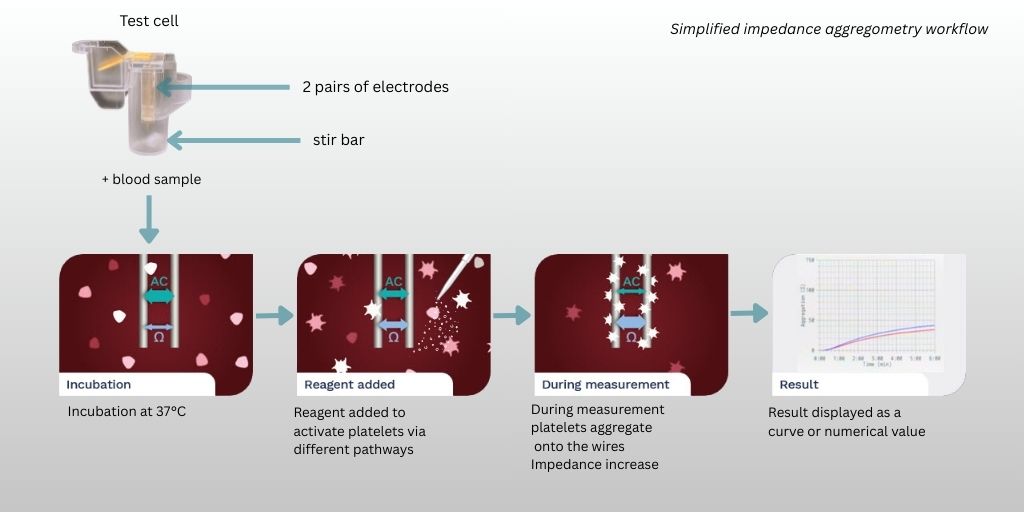
Although the underlying technology is sophisticated, the process itself can be broken down into a few clear steps.
- Whole blood sample preparation
A whole blood sample is collected using an appropriate anticoagulant. Because the sample remains largely unprocessed, pre-analytical handling plays a key role in test reliability.
The sample is then assessed under controlled and standardised conditions designed to support platelet activation and aggregation in whole blood. - Addition of platelet agonists
Specific agonists are added to the sample to stimulate platelet activation. These agonists mimic physiological triggers of platelet aggregation and allow different activation pathways to be assessed. - Platelet adhesion to electrodes
As platelets become activated, they adhere to the surface of metal electrodes within the test cell. This adhesion and aggregation gradually increases electrical resistance. - Measurement of impedance
The analyser continuously measures changes in impedance between the electrodes. The resulting signal reflects the extent and kinetics of platelet aggregation over time. - Result interpretation
The aggregation response is recorded and displayed as a curve or numerical value, which can be interpreted alongside clinical information, and other relevant laboratory results.
Why use whole blood for platelet testing?
One of the key advantages of impedance aggregometry is its use of whole blood rather than platelet-rich plasma.
Whole blood testing:
- Preserves interactions between platelets, red blood cells, and leukocytes
- Reduces sample preparation steps
- More closely reflects physiological conditions
- Helps minimise artefacts introduced during centrifugation
In addition, the relatively short test preparation and analysis time makes impedance aggregometry well suited to settings where timely platelet function information is important.
Common applications of impedance aggregometry
Impedance aggregometry is used in a variety of clinical and research contexts, including:
- Monitoring antiplatelet therapy
- Investigation of platelet function disorders
- Research into platelet activation pathways
- Assessment of platelet responsiveness under controlled conditions
Because multiple agonists can be tested, the method allows for a broad evaluation of platelet function across different activation mechanisms.
Key advantages of impedance aggregometry
- Physiological relevance
Testing in whole blood maintains cellular interactions that are lost in plasma-based methods. - Reduced sample manipulation
Fewer preparation steps can help reduce handling errors and pre-analytical variability. - Broad clinical and research utility
The method is well established across diagnostic and research environments. - Workflow suitability
Impedance aggregometry can be integrated into routine workflows when appropriately standardised.
Factors that influence test reliability
As with any platelet function test, results can be affected by several variables, including:
- Sample collection technique
- Sample transport and handling conditions
- Time from blood draw to testing
- Anticoagulant choice
- Instrument setup and standardisation
Understanding and controlling these variables is essential for achieving reproducible and meaningful results, particularly in busy testing environments.
Why impedance aggregometry remains relevant today
Impedance aggregometry continues to be widely used because it balances physiological relevance with practical implementation. Its ability to assess platelet function in whole blood makes it suitable for testing environments where timely and reliable results are important.
As testing environments face increasing pressure to improve reproducibility, efficiency, and traceability, there is growing interest in approaches that build on established methods while addressing known workflow challenges.
Looking ahead
Impedance aggregometry has become a cornerstone technique in platelet function testing. Understanding its principles helps users make informed decisions about method selection, workflow design, and result interpretation.
As platelet testing continues to evolve, accessible education remains essential for supporting quality, reproducibility, and confidence in results.
Educational use only
This content is intended for educational and informational purposes only and does not constitute clinical guidance. Testing practices and interpretation should follow applicable regulatory requirements and local laboratory procedures.
References
Michelson AD.
Platelets. 4th ed.
Cardinal DC, Flower RJ. The electronic aggregometer: a novel device for assessing platelet behavior in blood. J Pharmacol Methods. 1980 Feb;3(2):135-58. doi: 10.1016/0160-5402(80)90024-8. PMID: 7392654.
Davidson S. Monitoring of Antiplatelet Therapy. Methods Mol Biol. 2023;2663:381-402. doi: 10.1007/978-1-0716-3175-1_25. PMID: 37204725.
Paniccia R, Priora R, Liotta AA, Abbate R. Platelet function tests: a comparative review. Vasc Health Risk Manag. 2015 Feb 18;11:133-48. doi: 10.2147/VHRM.S44469. PMID: 25733843; PMCID: PMC4340464.
Tóth O, Calatzis A, Penz S, Losonczy H, Siess W. Multiple electrode aggregometry: a new device to measure platelet aggregation in whole blood. Thromb Haemost. 2006 Dec;96(6):781-8. PMID: 17139373.
Baker P, Platton S, Gibson C, Gray E, Jennings I, Murphy P, Laffan M; British Society for Haematology, Haemostasis and Thrombosis Task Force. Guidelines on the laboratory aspects of assays used in haemostasis and thrombosis. Br J Haematol. 2020 Nov;191(3):347-362. doi: 10.1111/bjh.16776. Epub 2020 Jun 14. PMID: 32537743.
Larsen JB, Hvas AM, Hojbjerg JA. Platelet Function Testing: Update and Future Directions. Semin Thromb Hemost. 2023 Sep;49(6):600-608. doi: 10.1055/s-0042-1757898. Epub 2022 Nov 16. PMID: 36384230.
Harrison P, Lordkipanidzé M. Testing platelet function. Hematol Oncol Clin North Am. 2013 Jun;27(3):411-41. doi: 10.1016/j.hoc.2013.03.003. PMID: 23714306.
Practical Haemostasis.
A Practical Guide to Haemostasis
The references listed support the general principles described in this blog. Access to full publications may depend on journal availability.
Transform your platelet function testing process with IMPACT
Send an Enquiry


